

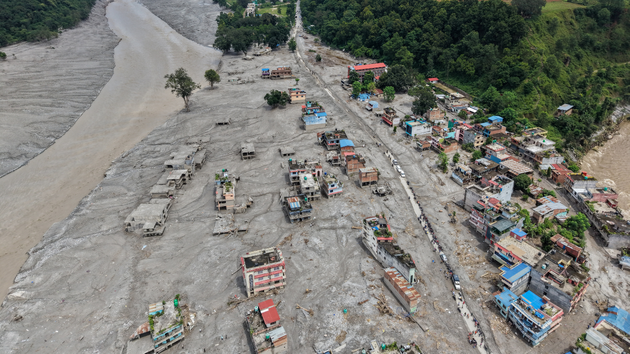
LONDON -- The death toll continues to climb days after massive flash flooding obliterated parts of the Nepal-Tibet border region on Wednesday, with at least 682 bodies recovered across the region and over 3,000 people missing, authorities said Saturday.
As search and rescue efforts continued in Nepal on Saturday, authorities said at least 7,514 people had been rescued, including 227 foreign nationals, according to the Nepal National Disaster Management Authority.
At least 219 injured people have received treatment or have been discharged as of Saturday, according to the disaster management authority.
In Nepal, 675 people have been reported dead and 2,498 others remain missing, according to the Nepal National Disaster Management Authority.
In the Chinese region of Tibet, seven people have been reported dead and 554 others have been reported missing, according to China state news agency Xinhua.
Among the missing are 90 Americans as of Friday, according to a State Department spokesperson. The department confirmed Friday that five Americans had been evacuated, up from three on Thursday.
The number of people considered missing has fluctuated significantly as recovery efforts have accelerated.
The flooding, captured in dramatic video footage, occurred in the northern Rasuwa district along the border with Tibet at around 8:40 a.m. local time Wednesday, authorities said. The flooding inundated areas along the Trishuli River, burying some buildings and damaging bridges and roadways.
The deadly wall of water that descended from the mountains on the border between Nepal and Tibet caused destruction at least 62 miles downriver from the border in Nepal, an ABC News analysis of verified video and satellite images shows.
The flood was reportedly triggered by a landslide about 12 miles northeast of the Rasuwagadhi border post along the Nepal-China frontier, according to Nepal Disaster Management.
A 5.2-magnitude landslide was registered in Nepal on Wednesday, according to the U.S. Geological Survey.
The seismic activity from the landslide was initially erroneously reported as a 4.4-magnitude earthquake, the agency said. It is unclear what triggered the landslide.
A geophysicist at Columbia University in New York told ABC News it appeared a landslide in the Himalayas took away a large glacier, or parts of one, in the mountain pass.
The initial location of the glacier was a cliff about 16,000 feet high. The debris avalanche, or landslide, slid down 6,000 feet on the slope, the USGS said.
While it will take time to determine how severe the landslide was, the USGS estimated that more than 100 million cubic meters of ice, rock and debris were displaced in the event, Ben Mirus, a research geologist with the agency, said Thursday.
Siddarth Venkatachalam, 30, told ABC News he had spoken to his mother just two or three hours before she went missing in the floods, as it was her birthday. Venkatachalam's mother was on a trip with his father and aunt, who are also among the Americans missing in Nepal.
"They were like excited for this trip," Venkatachalam said, visibly in shock. "It was like a spiritual, religious like trek they'd been looking forward to and preparing for."
The family said the three were located with Life360 on a bridge on the Tibetan border just before the flood.
In a statement, Nepal's Office of the Prime Minister expressed "deep sorrow" over the loss of life.
"Offering heartfelt tribute to all those who lost their lives in this natural disaster, it extends its sincere condolences to the bereaved families and relatives," the statement shared on social media said.
Meanwhile, the Nepali government on Thursday established an "Emergency Control Room ... to facilitate search, rescue, information verification and consular assistance in respect of foreign nationals affected by, missing in, or otherwise connected to the flood incident," according to Nepal's Ministry of Foreign Affairs.
U.S. President Donald Trump was asked about the Americans currently impacted by the deadly Nepal floods in the Oval Office Thursday. He called the disaster a "terrible thing" and said the U.S. is in active communication with Nepal's leadership and has offered to provide as much aid as necessary.
"That's a terrible thing. No, we are sending aid, and we've spoken to the leadership, and we let them know anything they want will happen," Trump said.
Copyright © 2026, ABC Audio. All rights reserved.