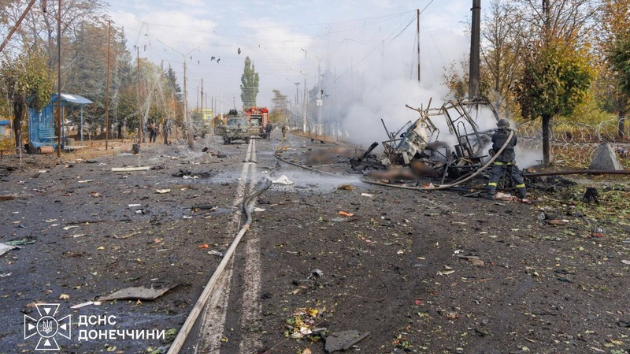
Firefighters perform cooling and search operations on the burnt shell of a passenger bus following a Russian missile and aerial bomb strike in Kramatorsk, Donetsk region, Ukraine on October 8, 2026. (Photo by State Emergency Service of Ukraine / Handout/Anadolu via Getty Images)
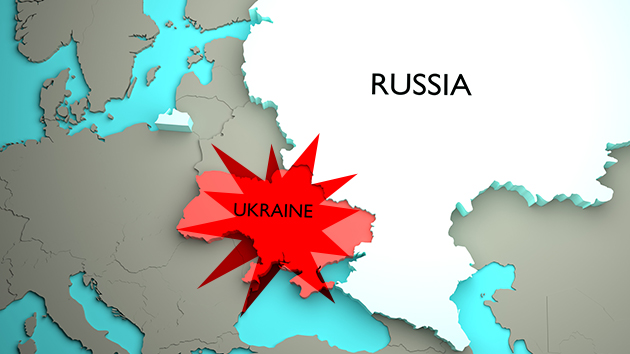
LONDON and LVIV, Ukraine -- At least 35 people were killed and over 30 others were injured across Ukraine in Russian attacks on the country overnight and into Thursday morning, according to Ukrainian authorities.
In a single strike on a passenger bus in Kramatorsk, in the Donetsk region, at least 30 people were killed and 18 were injured, according to a statement released by the city council on Thursday.
"Once again, the Russians have struck a location where there is absolutely no military target," the city council said. "A passenger bus. A civilian vehicle. People simply going about their daily business."
Public transport in Kramatorsk has been suspended, the statement added.
The killings overnight brought the death toll from Russian attacks across Ukraine over the past 48 hours to at least 60, following a deadly Wednesday in which at least 25 people were killed in strikes across the country, including 22 in an attack on a residential building in Pryluky.
At least four of the victims in Pryluky were children, officials said.
"Even after such a brutal attack, the Russians continued striking our regions," Ukrainian President Volodymyr Zelenskyy said on Thursday. "This morning, Russia hit an ordinary public transport stop in Kramatorsk with an aerial bomb."
LONDON -- Russia targeted Ukraine overnight with dozens of missiles and drones in a "vile" and deadly attack aimed at both energy infrastructure and residential buildings throughout at least 12 regions, Ukrainian President Volodymyr Zelenskyy said on Wednesday.
Russia in total fired some 70 missiles, "many" of which were ballistic, along with attack drones, Zelenskyy said.
"One of the key targets was our energy infrastructure," he added "The Russians wanted to strike painfully and demonstratively."
Russia's Ministry of Defense said it had launched a "massive strike" overnight targeting Ukraine's defense industries in Kyiv and other cities.
Five people were killed and another 26 were injured, including five children, as Russia hit an "ordinary" five-story apartment building in Pryluky, in the Chernihiv region, the president said in a statement.
"First responders are working nonstop at the site -- doing everything possible to find every person," Zelenskyy said.
Another two people were injured as missiles hit high-rises in Kremenchuk and apartment buildings in Dnipro, he said. Another two were killed in Kyiv and two others in Oleksandriya, he said.
The U.S. issued a formal diplomatic complaint known as a démarche over the Russian government's response to the reported death of a lab worker from an anti-plague institute in Siberia, urging the country to increase transparency surrounding the incident, ABC News has learned.
"We have officially requested additional information from the Russian government. We are also in official communication with other countries around the world to share information," a State Department spokesperson said.
A U.S. official said early Wednesday that the démarche was transmitted to representatives of the Russian government within the last few hours. The démarche itself is classified, but the official said it reminds Moscow of its requirements to comply with international health regulations.
The action came ahead of what President Donald Trump said was a scheduled call between him and his Russian counterpart, Vladimir Putin. Trump on Tuesday told reporters at the White House that the call had been scheduled and would happen "very soon," adding that it would be "probably tomorrow."
Trump said their conversation was expected to touch on the heightened scrutiny of Russia's response after some Russian media and public figures reported a death potentially connected to the Irkutsk Anti-Plague Institute.
Russian authorities have said only that that the case of the lab worker’s reported death was "pneumonia of an unknown cause," with the health agency Rospotrebnadzor saying tests showed no link with her work. They issued a statement saying that "no accidents have been detected at the Irkutsk Anti-Plague Institute while working with pathogenic microorganisms."
Rospotrebnadzor's office for the Irkutsk region issued on Tuesday a statement, saying, "A false message is being circulated online about the introduction of an enhanced sanitary and epidemiological regime and strict restrictions in the Irkutsk region."
The U.S. Embassy in Moscow said in a Tuesday health alert that it was aware of the press reports, saying, "We continue to track the situation closely." The State Department reminded Americans not to travel to Russia, saying the U.S. government has limited ability to help its citizens who go there. Additional restrictions may be in place for some regions, the embassy said.
Presidential press secretary Dmitry Peskov told reporters on Wednesday that official information would come directly from Rospotrebnadzor, adding, "the media are reporting a great deal right now, and the overwhelming majority of what the media are reporting around this situation is false information."
As Russian officials came under scrutiny, U.S. officials offered to provide assistance. Trump said the U.S. was willing to help Russia after the U.S. State Department announced it was monitoring the reportedly fatal case of "pneumonia of an unknown etiology."
"Anybody that has that kind of a problem, we're always willing to help," Trump told reporters Monday.
Asked about how the U.S. is planning to mitigate the risk coming from Russia, Trump said that his administration is "looking at it very strongly."
Russia said it would welcome help from the United States, but also sought to downplay concern.
"It is always very good when mutual assistance is offered," Peskov told journalists on Monday. Peskov then appeared to downplay Trump’s suggestion the issue was a “major problem for Russia,” telling a journalist he had not heard that framing.
"To be honest, I did not hear the president’s words that he considers this a major problem for Russia," Peskov said. "As far as I remember it was not said that way, although I may be mistaken."
Secretary of State Marco Rubio, asked Tuesday in Iceland by ABC News whether he had reason to believe there has been an accidental release of an intentionally modified strain of the plague, said it would "irresponsible for me here to sit and speculate because we just don't have all the information yet."
"I think it's incumbent upon Russia to obviously share more information with the world. That's what they should do," the secretary said.
Rubio said his department was tracking the situation "hour by hour."
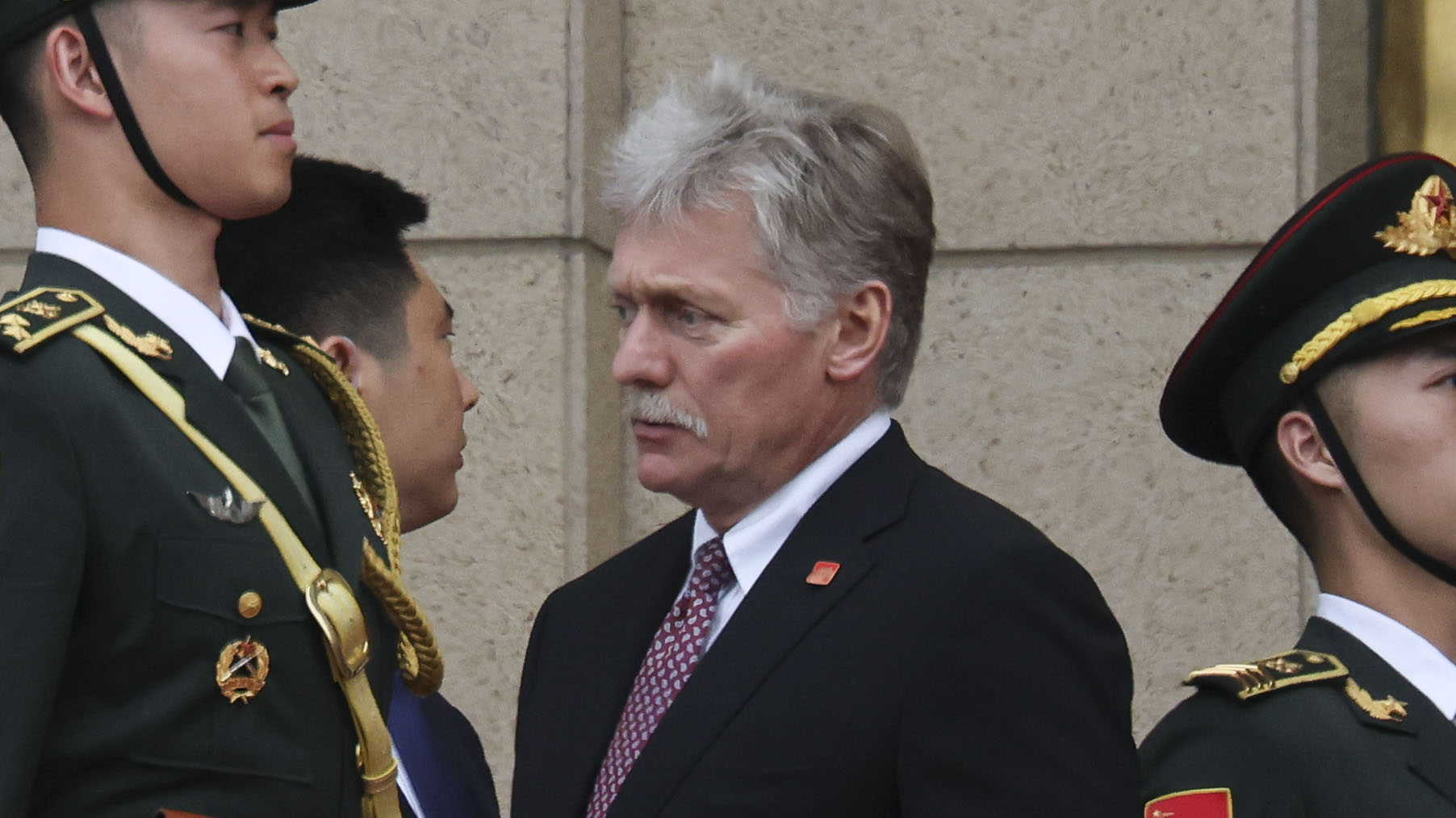
Kremlin spokesman Dmitry Peskov exits the Great Hall of the People on May 20, 2026, in Beijing, China. (Maxim Shemetov - China Pool/Getty Images)
The Kremlin on Monday said it welcomed President Donald Trump’s offer to provide assistance to Russia amid mounting global concern around the death of a lab worker from an anti-plague institute in Siberia, but gave no more details about the case.
“It is always very good when mutual assistance is offered,” presidential press secretary Dmitry Peskov told journalists.
Peskov appeared to downplay Trump’s suggestion the issue was a “major problem for Russia,” telling a journalist he had not heard that framing.
“To be honest, I did not hear the president’s words that he considers this a major problem for Russia. As far as I remember it was not said that way, although I may be mistaken,” Peskov responded.
He declined to give any further details on the suspected pneumonic plague case, saying all information should come from Russia’s consumer health agency, Rospotrebnadzor.
Meanwhile, Elena Sofyina, Deputy Mayor of the Shelekhov for Social Sector Management, commented on Donald Trump’s statement about his readiness to provide assistance.
“Information has emerged that Donald Trump is ready to help us deal with the pneumonia situation in the district. I believe it’s necessary to respond directly. We can handle it ourselves," Sofyina said.
"The situation is under full control. Rospotrebnadzor, the regional team, and the administration of the Shelekhovsky District are working together. The dangerous diagnosis has not been confirmed, but we are still following all the protocol measures,” Sofyina added.
Secretary of State Marco Rubio, asked in Iceland by ABC News whether he had reason to believe there has been an accidental release of an intentionally modified strain of the plague, said it would "irresponsible for me here to sit and speculate because we just don't have all the information yet."
"I think it's incumbent upon Russia to obviously share more information with the world. That's what they should do," the secretary said.
Rubio said his department was tracking the situation "hour by hour."
"Suffice it to say, we're watching it very closely, and I think the whole world is watching it very closely because, depending on what we learn about it, we would know how to respond," Rubio said.
"We encourage Russia to be transparent and share more information with the world, so that all of us could react accordingly and appropriately. But we'll have to make those decisions on the basis of the information that we're learning and are being provided. And so far, that's still quite limited. But hopefully, that will change in the next few hours and days," he added.
A State Department official on Tuesday confirmed the U.S. has made contact with the Russian government over a suspected plague death in Siberia.
“We have been in contact with the Russian government, including our health experts at the State Department with the Foreign Ministry as early as last Friday,” the official said.
Health authorities in the Siberia region of Irkutsk last week launched "anti-epidemic" measures after a lab worker from an anti-plague institute died in hospital. Local Russian media have named the worker as 28-year-old Daria Shipilova, who studied plague at the Anti-Plague Research Institute in the town of Shelekhov, just outside Irkutsk, which is about 2,600 miles from Moscow.
Russian authorities have said only that that the case of the lab worker’s death was “pneumonia of an unknown cause,” with the health agency Rospotrebnadzor saying tests showed no link with her work.
But on Tuesday, Rospotrebnadzor's office for the Irkutsk region issued a statement, saying "A false message is being circulated online about the introduction of an enhanced sanitary and epidemiological regime and strict restrictions in the Irkutsk region."
"We inform you that the said document and information are not related to official sources and are unreliable,” the statement said.
“The sanitary and epidemiological situation in the Irkutsk region and the cities of Irkutsk and Shelekhov is stable. A set of preventive measures and medical monitoring of contacts is nearing completion. Laboratory tests identified two cases of COVID-19 and two cases of rhinovirus infection. No other infectious disease pathogens were detected among the contacts,” the statement further said.
The statement came after some Russian media and public figures reported a death potentially due to plague and linked to a lab worker. Russian officials did not provide further details about the worker. The Russian agency's statement said that "no accidents have been detected at the Irkutsk Anti-Plague Institute while working with pathogenic microorganisms."
The Centers for Disease Control and Prevention (CDC) said in a statement Sunday that it is "monitoring the situation closely" with the State Department, adding "the safety and security of U.S. citizens is our highest priority."
"Many details have not been confirmed. We encourage Russian authorities to share accurate information quickly and openly," a State Department spokesperson said in a statement. "Plague is a known disease and is treatable with common antibiotics, especially when treatment starts early. Cases occur naturally in many parts of the world."
On Tuesday, the CDC said in a statement, in part, that "at this time, there is no indication of a broader threat to the United States, but CDC and our interagency partners are prepared and will continue to monitor the situation closely."
Plague is a disease caused by the bacterium Yersinia pestis, according to the CDC. There are three types of plague: bubonic, pneumonic and septicemic. Symptoms often include fever, chills and weakness. Plague can be treated with antibiotics. The earlier antibiotics are received, the higher the chances of a full recovery.
The U.S. averages about seven cases of plague each year, mostly in Western states, according to the CDC, which notes it has been more than a century since the U.S. has seen a documented case of person-to-person spread of plague.
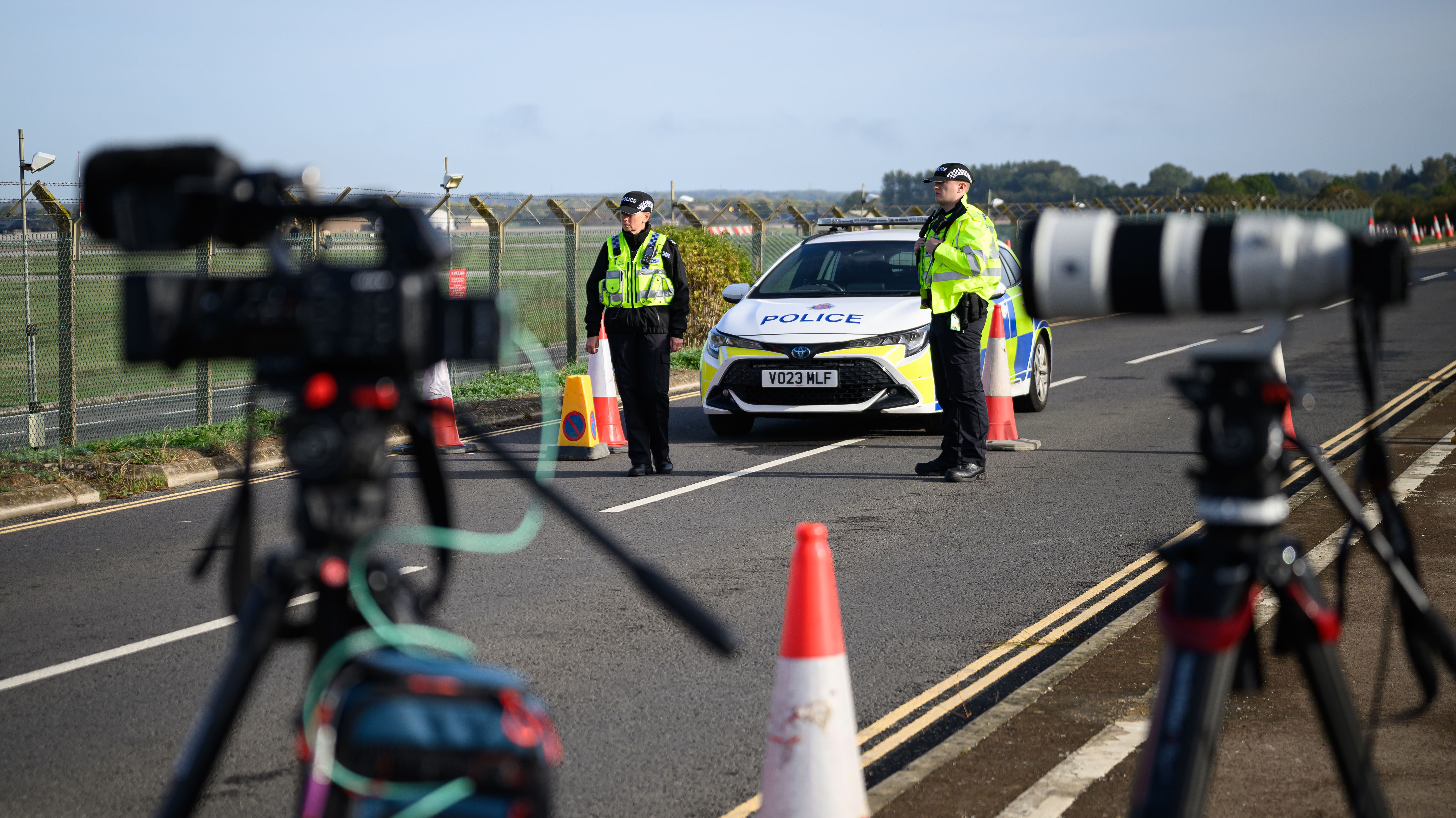
A police cordon remains in place near the runway of RAF Fairford on Sept. 28, 2026, in Fairford, England. (Leon Neal/Getty Images)
LONDON -- A 22-year-old British national was arrested on Tuesday morning in central London as part of an investigation by Counter Terrorism Policing into the potential plot last month near RAF Fairford, a military base that at the time hosted U.S. bombers.
The man arrested on Tuesday morning was detained on suspicion of preparation of terrorist acts, Counter Terrorism Policing said in a press release.
"This remains a live investigation and our specialist teams continue to pursue multiple lines of enquiry into the circumstances surrounding events near RAF Fairford," Vicki Evans, the senior national coordinator for Counter Terrorism Policing, said in a statement.
The arrest, which came as public interest in the investigation remained high, coincided with the search of a property nearby in Westminster, police said.
"We’re acutely aware of the public interest in this investigation, and we are working around the clock, and at pace, to identify the motivation behind events in Gloucestershire," Evans said on Tuesday. "We remain committed to investigating all possible angles."
Five men in their twenties were arrested in late September in a town near the base on suspicion of terrorism and explosives offenses, officials said. They were later released on bail, but were subject to "stringent conditions on their movement and contact with others," Laurence Taylor, head of National Counter Terrorism Policing, said at the time.
A sixth man, a 25-year-old dual U.K.-Iranian national, was later arrested and also released on bail, officials said.
The U.S. this week said it had pulled its heavy bombers from the air base, which had been used to launch strikes against Iran. President Donald Trump said Monday that the move was prompted by a direct threat to the installation as authorities investigate a suspected plot to attack it.
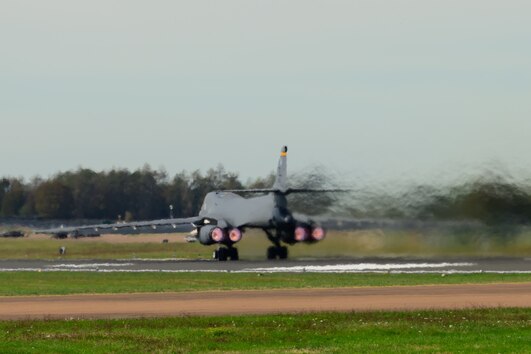
A U.S. B-1 bomber taxis to the runway to depart for home at RAF Fairford on Oct. 4, 2026, in Fairford, United Kingdom. (David Brown/Getty Images)
(WASHINGTON) -- The United States removed its heavy bombers from a base in the United Kingdom it had used to launch strikes on Iran, amid an investigation into a suspected plot to attack the base.
At least a dozen planes, including B-1 bombers, were redeployed to the United States from Royal Air Force Fairford, according to the Pentagon, which did not specify when or why the planes departed.
"While operational security precluded us from confirming the movement of our assets and forces in real-time, we can acknowledge now that all U.S. bombers that were deployed to RAF Fairford have re-deployed to their home stations in the United States," a Defense Department official said in a statement on Sunday.
Secretary of State Marco Rubio said Monday morning that the aircraft redeployment reflects a "regular rotation" and that he "wouldn't directly tie" the suspected plot regarding RAF Fairford to the action.
"[I]t's not unusual to see rotations happen and movement of assets to different parts of the world based on exercises, redeployments, people changing out and new people coming in, new planes coming in, old planes going out," Rubio said.
The Pentagon's statement on the departure came after five men were arrested last month on terror charges near RAF Fairford.
They were arrested in possession of three vans in the village of Whelford, which is about 2 miles from the base, which hosts the U.S. Air Force and has since February been serving as a key hub for American operations against Iran -- including for heavy bombers like the B-1.
The five were later released on bail after "extensive interviews," authorities said.
The suspects, who have not been charged, "remain under investigation as we explore multiple lines of enquiry," Laurence Taylor, head of National Counter Terrorism Policing in the United Kingdom, said on Sept. 28.
Prime Minister Andy Burnham told the BBC News in late September that there were "strong indications" that Iran "played a part in what happened."
The Department of Defense said in its Sunday statement that the "U.S. Air Force bombers routinely operate around the world to support global force readiness and operational requirements."
"The Airmen that operate America’s bomber force, including B-1s, B-2s, and B-52s, remain ready to deliver precision global strike capabilities – including through operations that launch and recover from the continental United States – anywhere, anytime," the statement said.
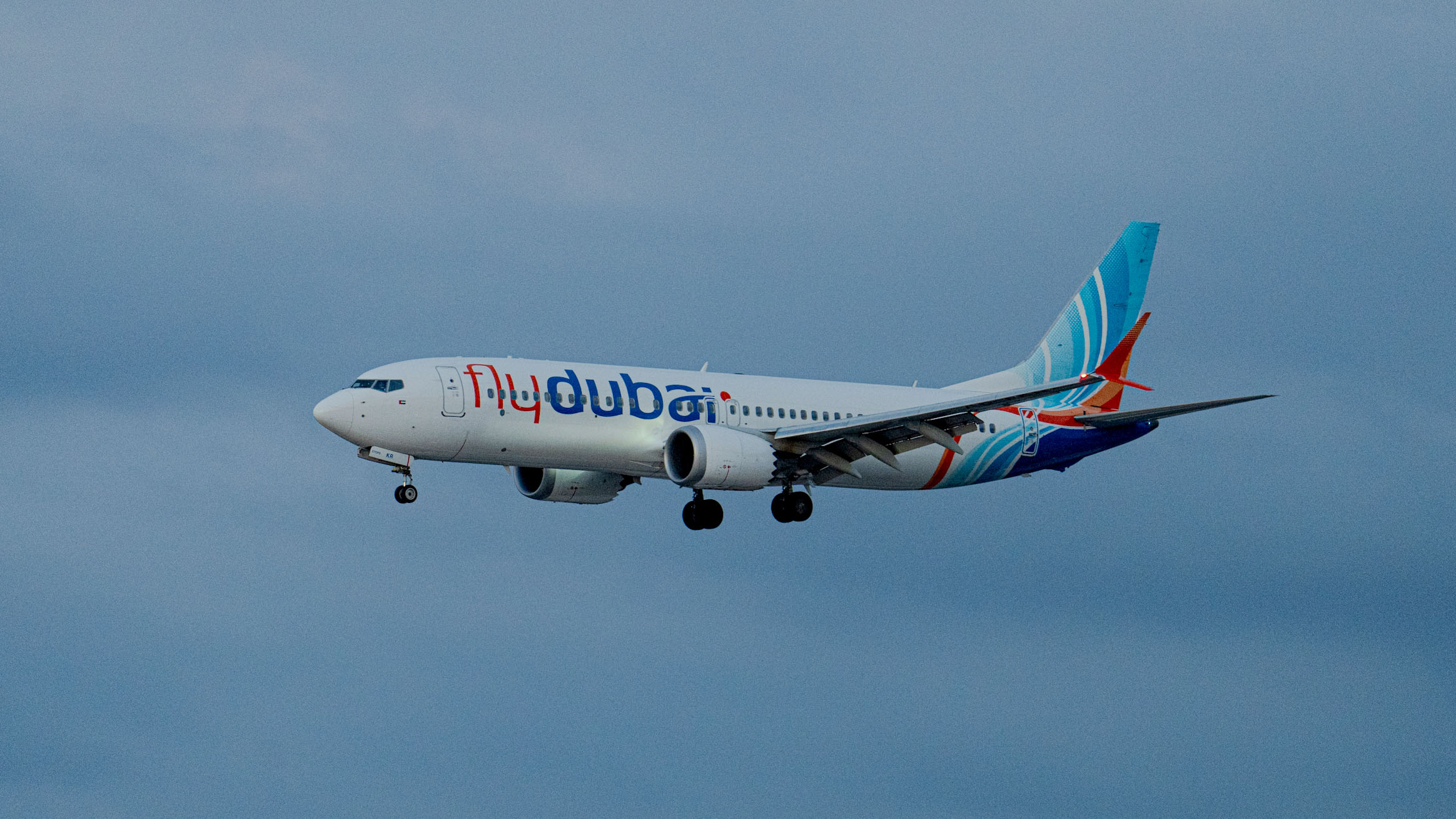
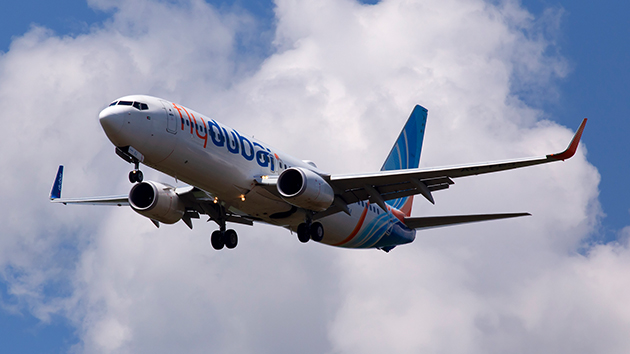
A plane carrying passengers from an earlier Flydubai flight that was diverted to Saudi Arabia arrives at Ben Gurion Airport on Sept. 30, 2026, in Tzafria, Israel. (Erik Marmor/Getty Images)
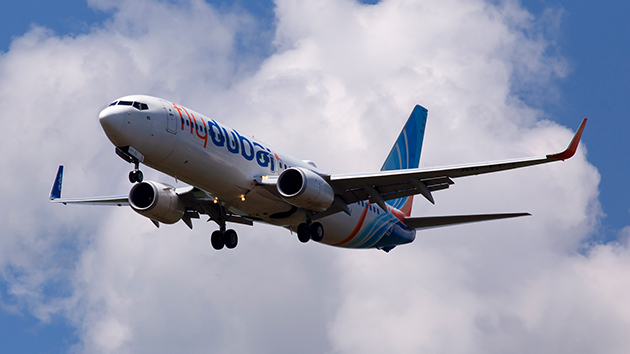
(WASHINGTON) -- The alleged attacker on the FlyDubai flight to Israel was intending to crash the plane into Tel Aviv's Ben Gurion Airport, according to two senior U.S. officials and an Israeli source familiar with the investigation.
As ABC News has previously reported, Hamam Al-Hammani, an Omani national, had been flagged by Oman Air as a security risk and was suspended as a trainee copilot for that airline in 2024 for possessing extremist materials, according to senior intelligence and law enforcement officials, raising questions about how he was hired at FlyDubai.
Officials investigating the incident are still trying to determine how the suspected attacker was subsequently permitted to fly for FlyDubai and how he ended up as the first officer in the cockpit of a plane headed for Israel, the sources said.
"We recognize that there are many questions at this stage; however, the circumstances surrounding the incident are still under investigation," FlyDubai said in a statement to ABC News on Saturday.
"We are therefore not in a position to comment further beyond our published statements. We remain fully committed to supporting the ongoing investigation and are in close coordination with the relevant government authorities and regulators."
FlyDubai issued a statement earlier Friday, attributed to its chief executive officer, saying that, at the request of the authorities, FlyDubai had "temporarily suspended operations to Tel Aviv until further notice," and saying "a full official investigation, led by the relevant authorities and fully supported by FlyDubai, is underway."
A disaster was averted when the flight's captain, Smit Machchhar, fought back and a number of passengers subdued and restrained the attacker, who plunged the plane thousands of feet in an apparent attempt to crash it, in what Israeli officials are saying was an act of terror.
Prime Minister Benjamin Netanyahu said the intention was to "crash the plane, killing everyone on board" Flight 1073 from Dubai.
A passenger, Yaniv Hayun, was able to drag the suspect from the cockpit, take control of the plane and level it before a third pilot took over and flew the jet to Saudi Arabia, according to other passengers.
The plane was diverted to Tabuk, Saudi Arabia, where it made an emergency landing.
Al-Hammami was transferred Thursday from Saudi Arabia to the United Arab Emirates and remains in custody.
"He came to crash the plane with all passengers on board," Netanyahu said in a video released by his office. "We are investigating whether he was sent, and whoever sent him will pay a very heavy price."
This is a developing story. Please check back for updates.
TOKYO and LONDON -- The III Marine Expeditionary Force in Japan confirmed on Monday that Devin Jacob Ballard, 20, a Marine lance corporal, was the service member arrested on Sunday on suspicion of murdering a Japanese woman in a city near a U.S. base.
Ballard is assigned to the III MEF, a spokesperson told ABC News, adding that the force would not release further personal or administrative details "to protect the integrity of the ongoing investigation and adhere to privacy regulations."
Asked whether the arrest has prompted any additional measures, including changes to liberty or personnel restrictions, 1st Lt. Tyler N. Thomas, media engagement officer for the III MEF, told ABC News, "All U.S. service members in Japan are subject to strict off-duty conduct and liberty guidelines."
"While we continuously review our security posture and force discipline, we have no announcements regarding changes to liberty policies at this time," Thomas added.
Ballard, who was named on Sunday by the Japanese media, was arrested on Sunday after the woman's body was found early on Saturday in Naha, the capital city of the Okinawa prefecture. Police identified the deceased as Anna Yagi, 39, saying she was pronounced dead at the scene after being found at about 4:30 a.m. on Saturday.
Ballard was arrested on suspicion of murder and robbery. Police found Anna Yagi’s backpack near the hotel with her wallet still inside. Surveillance video indicates the suspect left the scene on foot.
Investigators are examining Ballard’s movements before and after the incident and the nature of his relationship with Yagi.
Japanese officials lodged what they described as a "strong" protest against the United States on Sunday, as word of the apparent killing spread.
"The occurrence of such an extremely brutal and heinous incident is a matter of profound regret, and as the Government of Japan, we have lodged a strong protest with the U.S. side," Japanese Prime Minister Sanae Takaichi said on Sunday.
Shinjiro Koizumi, the Japanese minister of defense, said late on Sunday that his office summoned local U.S. military leaders to convey "Japan's extremely serious concern regarding the robbery and murder incident that occurred in Naha City, Okinawa Prefecture, while strongly protesting to the U.S. side."
When asked whether the case could fuel distrust of the U.S.- Japan alliance, Koizumi said the incident must not be allowed to shake public confidence in that alliance, including among Okinawa residents.
The United States has more than 50,000 soldiers, sailors, airmen and Marines stationed throughout Japan, including on several bases in Okinawa, an island chain in the south. Okinawa hosts a large share of the U.S. military presence in Japan and remained under U.S. administration until its 1972 reversion to Japan.
Ballard's force, the III Marine Expeditionary Force, said on Sunday that it was "actively cooperating with Japanese authorities," adding, "We extend our deepest condolences to the victim’s family and friends."
A U.S. service member was arrested on suspicion of murder and robbery after a Japanese woman's body was discovered in a hotel in Okinawa, local officials said, describing the alleged killing as a "heinous" incident that prompted the Japanese government to lodge a protest with the United States.
Shinjiro Koizumi, the Japanese minister of defense, said a U.S. Marine lance corporal was arrested on Sunday after the woman's body was found early on Saturday in Naha, the capital city of the Okinawa prefecture.
NHK, Japan's public broadcaster, identified the suspect as Devin Jacob Ballard, 20, who was stationed at U.S. Marine Corps Air Station Futenma, a base a few miles outside Naha. The broadcaster identified the alleged victim as Yagi Anna, 39, saying she was pronounced dead at the scene after being found at about 4:30 a.m. on Saturday.
Japanese Prime Minister Sanae Takaichi said the Okinawa Prefectural Police were investigating the incident as a murder.
"The occurrence of such an extremely brutal and heinous incident is a matter of profound regret, and as the Government of Japan, we have lodged a strong protest with the U.S. side," she said on social media.
NHK reported that security camera footage showed a person who "appeared to be foreign entering the hotel with a woman and later leaving with her belongings." Some of Yagi's belongings were allegedly found abandoned near the hotel, NKH reported, citing local police.
The hair and tattoos of the person in the security camera footage reportedly resemble Ballard's, according to NHK, which also reported that he is suspected of killing Anna between 2 a.m. and 4 a.m. local time Saturday and stealing her wallet and other unspecified belongings. Ballard was located late Saturday night in an entertainment district in Okinawa City, about 18 kilometers away from the hotel, and was arrested, according to NHK.
Anna's cause of death was suffocation caused by pressure on her neck, NHK reports police saying. Ballard has denied killing Anna, police said, according to NHK.
U.S. officials did not immediately confirm the identity of the service member who was arrested, nor did they say whether the person had been officially charged in connection with the death.
"We are actively cooperating with Japanese authorities, in response to allegations of serious criminal actions by a Marine assigned to the III Marine Expeditionary Force," the force said in a statement on social media. "We extend our deepest condolences to the victim’s family and friends."
Tens of thousands of U.S. troops are stationed across Japan, including in the country's southernmost prefecture, Okinawa, which is home to several U.S. bases.
The U.S. Embassy in Tokyo said it was aware of the incident and was extending "our deepest condolences to the bereaved family of the deceased."
"At present, an investigation is underway to clarify the facts, and the United States Government continues to cooperate closely with the Government of Japan and local authorities," the embassy said in a statement.
George Glass, the U.S. ambassador to Japan, said he had spoken on Sunday morning with the Ministry of Foreign Affairs and Okinawa's governor, adding that his office was providing full cooperation with an investigation into the death.
The office of Toshimitsu Motegi, Japan's foreign minister, said it had summoned Glass on Sunday to issue a protest.
Motegi "strongly urged the U.S. side to strengthen discipline and to prevent the recurrence of incidents so that such a tragedy will never be repeated," his office said in a press release.
Okinawa Gov. Genta Koja called on Sunday for the U.S. military in Japan to "rigorously enforce discipline among its service members."
"As Okinawa Prefecture, we will deal with this strictly, including by lodging strong protests with the U.S. military and both the Japanese and U.S. governments, to ensure that such tragic incidents never happen again," he said in a statement.
ABC News' Rashid Haddou and Joe Simonetti contributed to this report.
FlyDubai captain Smit Machchhar recounted the harrowing moments when he was attacked by his co-pilot during a flight from Dubai to Tel Aviv Wednesday, telling Indian Prime Minister Narendra Modi that he knew he had to act to save the passengers aboard the plane.
Machchhar spoke with Modi in Hindi in a video call released Friday by the prime minister's office.
Machchhar, who was seriously injured in the attack, said he realized he was not only fighting to save his own life but also the lives of everyone on the plane.
“When I was lying on the floor, I could feel that the aircraft was plunging and I said to myself while I was getting beaten, ‘This is the last push, Smit, do it, the door is right there,’” Machchhar said.
“Somehow, I opened the door, and everyone came in and everyone else had an equal role in the rescue,” he said. “I was trying to save myself, but I also knew that I can’t let anyone die.”
The flight plunged thousands of feet during the incident before Machchhar, who has been flying for 17 years and had been a captain for 11 years, managed to open the cockpit door, allowing passengers and crew members to intervene. The plane was diverted to Tabuk, Saudi Arabia, where it made an emergency landing.
“I was fighting for my life in that moment,” Machchhar said, describing the attack. “It was a moment when I thought, because I had fallen on the floor, I was wounded and fell down.”
He said his experience as a pilot helped him understand what was happening even while he was injured.
“Even if I shut my eyes, I can tell what is happening inside a plane,” he said.
During the call, Modi asked Machchhar how he was feeling.
“I am fine and everything is all right,” Machchhar replied.
“The entire country is praying for you,” Modi told him.
Modi praised Machchhar for his courage, patience and presence of mind, saying he had made a split-second decision that saved the lives of many people.
“You took a decision in a fraction of second and saved the lives of so many people,” Modi said. “Today, the whole country can say this with pride: We Indians are not killers, we are life savers.”
Modi also praised Machchhar for thinking about the passengers despite being seriously injured himself.
“And the biggest thing is you enhanced the honor of 1.4 billion Indians and that is why I am feeling proud from my heart,” Modi said.
Machchhar told Modi that he was his “biggest idol” and said he was proud that the prime minister had called him.
Machchhar has been recovering after receiving initial treatment in Tabuk and being transferred to Abu Dhabi for continued medical care.
Modi said prayers had been offered for Machchhar's recovery at temples and other holy places across India.
“Yesterday, prayers and chants were offered in all the temples and holy places, wishing for your long life, and we all are praying for your good health,” Modi said. “You are going to be in good health very soon and India is very eager to welcome you.”
ABC News' Victoria Beaule contributed to this report.
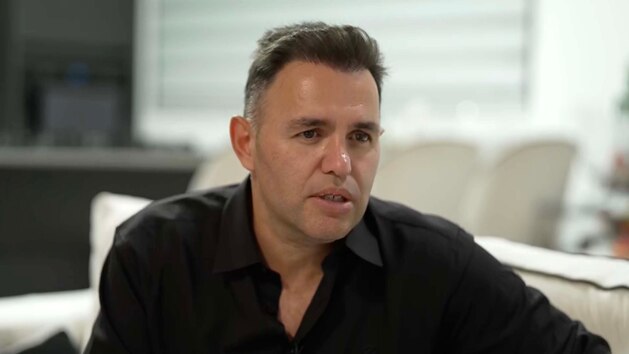
ABC News spoke with Dr Shota Musaev, an Israeli dentist who was sat in row 13 on that Fly Dubai flight from Dubai to Tel Aviv. (ABC News)
In a flash, Israeli dentist Dr. Shota Musaev went from being another passenger aboard FlyDubai Flight 1073 to a quick-thinking hero who helped save the life of the jet's captain after he was attacked inside the cabin.
Musaev told ABC News on Thursday that when he and a group of passengers rushed to the cockpit after Capt. Smit Machchhar was attacked, he did not hesitate to do something.
"I think, how [can] I help this situation for all [the passengers for all plane. How I can help," he told ABC News in an interview at his home in Tel Aviv. "And I see one pilot on the floor, with … blood."
An unidentified co-pilot allegedly attacked Machchhar with a knife and took the plane into a nose dive in an attempt to crash the plane during its flight from Dubai to Tel Aviv, Israeli officials said.
Another passenger, Yaniv Hayun was able to drag the suspect from the cockpit, took control of the plane and leveled it before a third pilot took over and flew the jet to Saudi Arabia, according to other passengers.
After the plane was leveled, Musaev said he saw the suspect and, with another passenger, tied the suspect's hands up with headphones. The dentist said the suspect, who is now in custody , said little other than that he was from Oman and then told him "Kill me, kill me, please."
"Once he had been subdued, caught, he didn't resist," Musaev said.
The dentist said he quickly turned his attention to Capt. Machchhar, who was bleeding from wounds to his head, neck and hands. Musaev said he began applying pressure to the wounds to stop the bleeding.
"Everything will be good," Musaev said he told the pilot as he treated him. "He said to me, 'Help me, please. Help me, please. I don't want to die here.'"
The plane landed in Saudi Arabia, where the passengers were given medical treatment. The whole ordeal lasted around 40 minutes, Musaev said.
He said on Thursday he was still only understanding what they had been through. “Do you understand we were five to ten seconds from dying?” he said, choking up.
Captain Machchhar was treated at a local hospital in Saudi Arabia and has now been transferred to another hospital in the United Arab Emirates, according to the Indian consulate in Dubai.
"He was speaking openly, smiling and laughing, which was a great relief for us and, above all, for his family," the Indian ambassador said in a statement Thursday.
The co-pilot is in custody in Abu Dhabi, according to officials from Saudi Arabia
Musaev said he hoped to reunite with the captain one day and express his gratitude for saving him and his fellow passengers despite his injuries.
"We'll say thank you very much for all," he said, adding that it was a collective effort in handling the situation.
Indian Prime Minister Narendra Modi has praised Capt. Smit Machchhar, the FlyDubai captain credited with intervening to help save the flight from disaster on Wednesday.
"Captain Smit Machchhar has shown the world the highest form of courage. Without fearing for his own life, he fought valiantly and prevented another 9/11 like attack from happening," Modi said Thursday morning.
The Indian consulate in Dubai said India's ambassador and consul general in the UAE met with Machchhar's family members.
"They briefed the family about Captain Machchhar’s health & recovery, conveyed that the Embassy & Consulate are in touch with the UAE authorities, and assured the family of continued support," the statement said.
Meanwhile, prosecutors in the United Arab Emirates have opened an investigation into the incident involving a FlyDubai flight that was diverted to Saudi Arabia after an altercation in the cockpit, the state news agency WAM reported Thursday.
The UAE attorney general ordered an investigation to establish the circumstances and motives behind the incident and "determine whether it was linked to any terrorist activity or prior planning," WAM said.
UAE judicial authorities have jurisdiction over the investigation because the aircraft is registered in the UAE and operates under its flag, meaning offenses committed on board are subject to UAE law even when they occur outside the country, the statement said.
The flight took off at 7:05 a.m. local time from Dubai Wednesday, according to Flightradar24.
Tracking data showed the aircraft descended rapidly from 34,000 to 16,000 feet in three minutes.
About 10 minutes after the initial descent, the plane's squawk code -- used by aircraft to communicate with air traffic control -- changed to "general emergency." Seven minutes later, the squawk code changed again, indicating a hijacking or "unlawful interference."
The aircraft then continued flying at an average altitude of about 15,000 feet until it landed in Tabuk, Saudi Arabia, roughly an hour to an hour and a half after the rapid descent began and the emergency signals were sent.
FlyDubai confirmed that the flight "experienced an incident while en route" and landed in Tabuk.
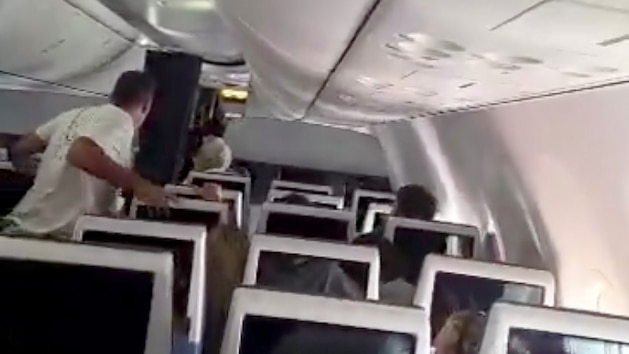
An image from a video circulating online taken by a passenger inside a FlyDubai flight from Dubai to Tel Aviv that was diverted to Saudi Arabia, Sept. 30, 2026, after an incident took place inside the cockpit. (Obtained by ABC News)
Passengers aboard FlyDubai Flight 1073 expressed fear, anger and ultimately elation after they survived what Israeli officials said was an attempted terror attack thousands of feet in the air on Wednesday.
After the passengers, many of whom were Israeli citizens, returned to Tel Aviv following the ordeal, many said they were still bewildered over what transpired during their flight from Dubai.
The plane's first officer allegedly stabbed the plane’s captain and then made the plane descend rapidly, Israeli officials said, with passengers saying they felt the impact almost immediately.
"I guess usually there's like some turbulence and you feel like whoa, but then it like evens out pretty quickly, and here it wasn't like that," Mika Bauman, who was aboard the flight told ABC News. "It was...like chaos screaming and just the crazy drop. Like you look at the ground and you're like, 'OK, I'm going that way right now.'"
Another passenger, who identified herself as Miram, told Israeli media that things got scary when passengers heard the screams coming from the cockpit and saw the bloody pilot.
"We felt like we were, like, going to crash. I was already screaming [the Jewish prayer] 'Shema Israel' and saying, 'I can't die, I'm my only daughter, I can't do this to my mother,' the woman added.
Israeli officials said that some of the passengers worked together to subdue the suspect while another flight crew member was able to take back the plane.
"Here was a crazy man with a knife who stabbed one of the pilots. We jumped and helped the pilot. Friends, everything is OK now, as you can see we are landing in Saudi Arabia, you can see I am fine. That’s it," passenger Itzhak Liber said in a Hebrew language selfie video posted to Facebook after the incident was over.
The jet was diverted to Saudi Arabia, where the injured pilot was taken to the hospital and the passengers were repatriated later in the day. The unidentified suspect remains in custody and the investigation is ongoing.
When the repatriation flight landed in Tel Aviv later, the passengers arrived to a warm welcome.
"It feels amazing in that it'll probably take me a little while to get on the plane again. But I'm honestly just thanking God that I'm here right now because it was so close to not happening based on the whole situation that we were just in," Bauman said after she landed in Israel.
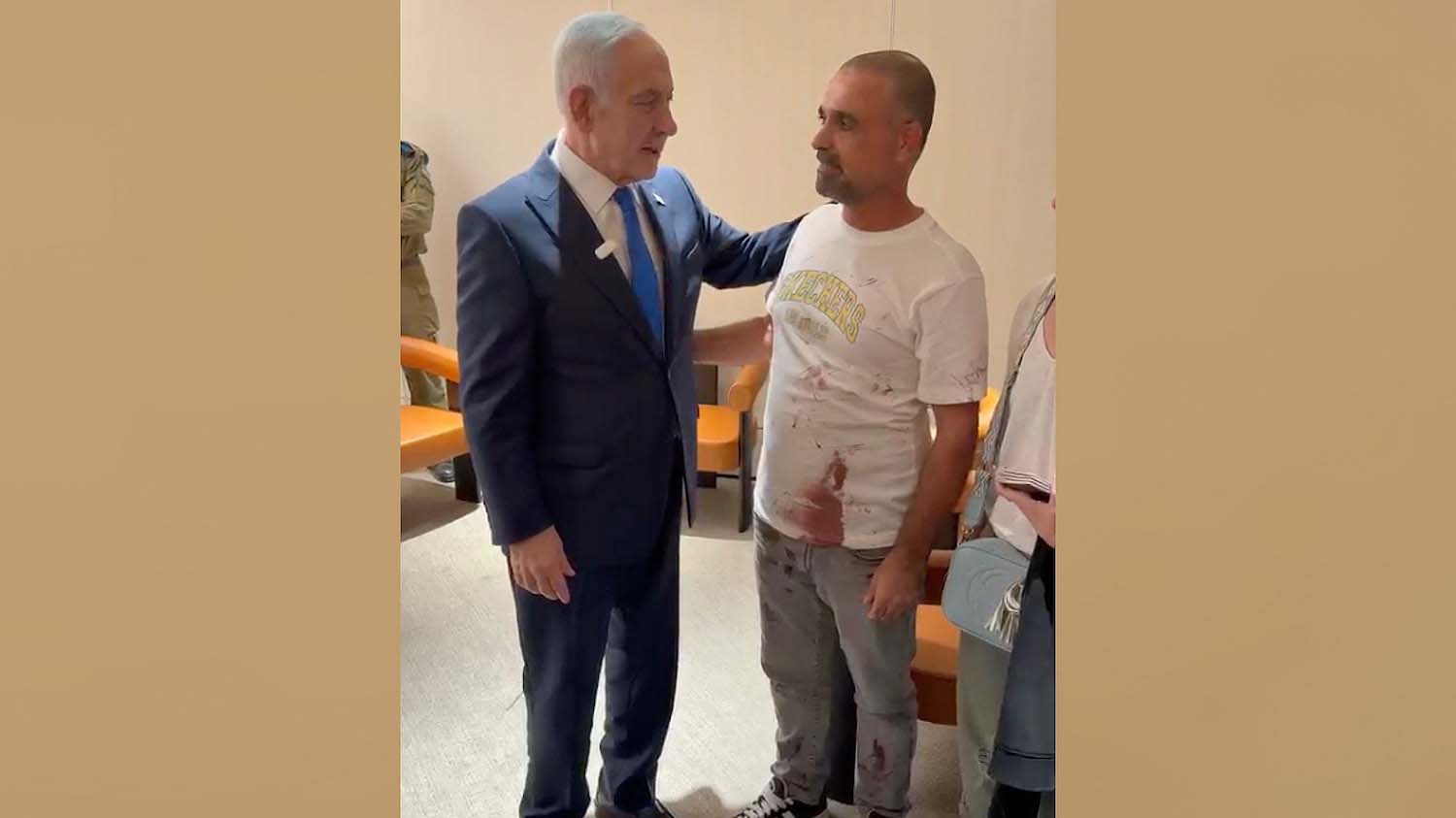
Israel's Prime Minister Benjamin Netanyahu meets with one of the passengers involved in subduing an attacker during a flight on a FlyDubai plane, after he arrived at Ben Gurion International Airport, near Tel Aviv, Israel, Sept. 30, 2026. (Prime Minister's Office)
(LONDON) -- A man who was among a group of passengers who subdued an attacker on a flight to Tel Aviv on Wednesday was welcomed by Israeli Prime Minister Benjamin Netanyahu when he returned to Israel later in the evening.
The prime minister posted a video of meeting the passenger named Yaniv Hayun, who still had blood on his shirt from the encounter.
Yaniv and a group of other passengers aboard FlyDubai Flight 1073 were able to get into the cockpit after an unidentified pilot stabbed the co-pilot, Capt. Smit Machchhar and took control of the plane, Israeli officials said.
The suspect allegedly plummeted the plane in an attempt to crash it and kill everyone aboard, Israeli investigators said.
"And then there was a very sharp nosedive down, something that threw me to where the flight attendants stand in front of the cockpit, I flew sideways," Yaniv said.
Yaniv said he placed the attacker in a chokehold and pulled him out. And then he quickly went for the plane's controls and briefly flew the plane.
"And the plane started to level out a bit more, and then the (third) pilot told me he's taking control from here," he said.
The third pilot flew it to Saudi Arabia, where the plane landed and the passengers disembarked. Capt. Machchhar was being treated for his injuries and the suspect is in custody, officials said.
"I imagine if we entered the sky of the country it wouldn’t have been good," Yaniv told the prime minister during their meeting.
NATO military aircraft were scrambled in both Poland and Romania overnight into Wednesday morning, as Russia launched its latest deadly drone and missile attack on Ukraine, which authorities said set multiple fires in Kyiv and left a dense fog hanging over the capital.
Ukraine's air force said that Russia launched 188 drones -- 86 of which were jet-powered -- and an unspecified number of ballistic and cruise missiles into the country overnight. The air force said that five missiles and 155 drones were destroyed or neutralized, with impacts reported across 18 locations. Kyiv was the focus of the attack, the air force said.
At least three people were killed and six others injured by strikes in Kyiv, according to updates posted to Telegram by Mayor Vitali Klitschko.
Ukraine's State Emergency Service reported that the strikes caused multiple fires in the capital, noting the "dense fog" hanging over the city on Wednesday morning.
"This is a consequence of previous shelling. The remnants of smoke and soot have risen to the upper layers of the atmosphere, and a high-pressure system is temporarily pressing them down to the ground," the SES wrote in a post to Telegram.
Ukrainian President Volodymyr Zelenskyy said in a post to Telegram that the overnight attacks were "intense" and focused on "the energy infrastructure of Kyiv and the surrounding region."
Fourteen people were injured nationwide, Zelenskyy said, with attacks reported in the Zhytomyr, Mykolaiv, Kirovohrad, Rivne, Odesa, Sumy, Kharkiv, Kherson and Cherkasy regions.
Zelenskyy thanked foreign partners who have recently committed new air defense support to Ukraine. "Every interceptor missile truly saves lives. And the closer we get to winter, the more of this protection we need. We must do everything to ensure that Russia's strategy of ballistic and drone terror fails," he wrote.
Beyond Ukraine's western borders, the latest wave of Russian attacks prompted activity in Poland, Romania and Moldova.
In Moldova -- which borders western Ukraine and is not a NATO member -- the national police force said in a post to Facebook that a drone exploded and damaged a communications antenna in the Anenii Noi district in the center of the country. Police personnel were dispatched to the site to investigate the incident, police said.
Poland's Armed Forces Operational Command said in a post to X on Wednesday morning that military aviation was active in response to Russian strikes in western Ukraine "using jet-powered unmanned aerial vehicles."
Romania's Defense Ministry said in a post to X that its forces "detected an aerial target maneuvering east of Izmail, on Ukrainian territory, near the river border with Romania."
Two Spanish F-18 jets were scrambled "to monitor the situation," the ministry added. "No incursions into national airspace were detected," it said.
Russia's Defense Ministry said its latest attacks on Ukraine were aimed at targets including "a communications center in Kyiv, energy infrastructure facilities in the Kyiv region that support military production and infrastructure in the port of Izmail."
The Defense Ministry in Moscow said its forces also shot down at least 384 Ukrainian drones overnight.
A FlyDubai flight from Dubai to Tel Aviv was diverted to Saudi Arabia Wednesday morning after an incident took place inside the cockpit, an Israeli security source told ABC News.
An Israeli security source confirmed to ABC News there was a violent altercation on the flight and that Israel is investigating the incident as a potential terror incident.
The flight landed in Tabuk, in northwestern Saudi Arabia, after being diverted.
Israeli Prime Minister's Benjamin Netanyahu's office said in a post to X that Netanyahu "held consultations on the matter and is monitoring developments."
"The incident is under control, and all measures are currently being deployed in order to return the Israeli passengers safely to Israel," Netanyahu's office added.
The flight, which was carrying mostly Israeli passengers, took off at 7:05 a.m. local time from Dubai, according to Flightradar24.
Tracking data showed the aircraft descended rapidly from 34,000 to 16,000 feet in three minutes.
About 10 minutes after the initial descent, the plane's squawk code -- used by aircraft to communicate with air traffic control -- changed to "general emergency." Seven minutes after that, the squawk code changed again, indicating a hijacking or "unlawful interference."
The aircraft then continued to fly lower at 15,000 feet on average until it landed in Tabuk, Saudi Arabia, about an hour to an hour and a half after the rapid descent began and the emergency signals were sent.
FlyDubai confirmed that the flight "experienced an incident while en route," and landed in Tabuk.
An Israeli security source confirmed to ABC News that the Israel Defense Forces recommended that a military aircraft be sent to repatriate Israeli passengers from Saudi Arabia.
This is a developing story. Please check back for updates.
ABC News' Victoria Beaule and David Brennan contributed to this report.
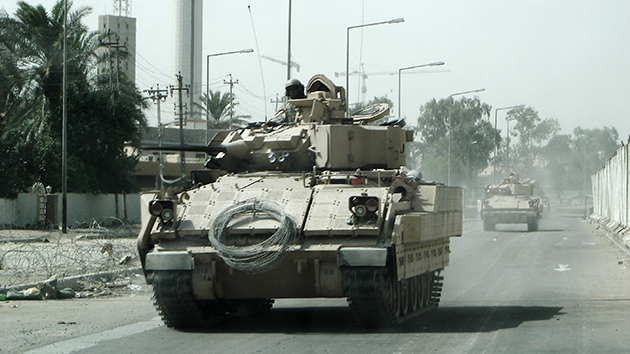
The U.S. military is expected to complete the total withdrawal of U.S. troops from Iraq on Wednesday after a 12-year presence prompted by the war against the Islamic State militant group ISIS.
It will be the second time that the U.S. has withdrawn all of its military forces from Iraq.
In 2011, the U.S. pulled out after an eight-year presence that began with the U.S. invasion of Iraq in 2003. U.S. troops returned in 2014 as ISIS conquered wide swaths of Syria and northern Iraq and threatened the approaches to Baghdad. The U.S. defeated ISIS militarily in 2019, but the continued U.S. presence was seen as a necessary one to prevent a resurgence of ISIS.
The withdrawal was negotiated with Iraq by the Biden administration in 2024, and the Trump administration has continued with the withdrawal plan that set Sept. 30 as the final pullout date. But the U.S. war with Iran has created a different regional situation for Iraq and the United States than when the deal was agreed upon.
Iraq and Iran have a shared Shiite cultural heritage and Iran has militarily assisted Shiite-militias inside Iraq. It remains a question how far Iran will be able to increase its presence and influence in Iraq and whether ISIS could become resurgent.
In recent years, there had been about 2,500 U.S. troops in Iraq.
Throughout this year, the U.S. has been consolidating its positions throughout the country into northern Iraq, but has quietly been moving forces out of Erbil since the start of the war with Iran. In recent months the reduction of forces proceeded along and there has been a very small U.S. presence in northern Iraq for quite some time.
Earlier this year the U.S. withdrew its forces from eastern Syria. That was an unplanned withdrawal spurred by the new Syrian government’s push against the United States' Syrian Kurdish partners.
With Wednesday's expected withdrawal, the U.S. will once again end a military presence inside of Iraq that has stretched for more than two decades and was the scene of approximately 4,500 U.S. military deaths, the vast majority occurring between 2003-2011.
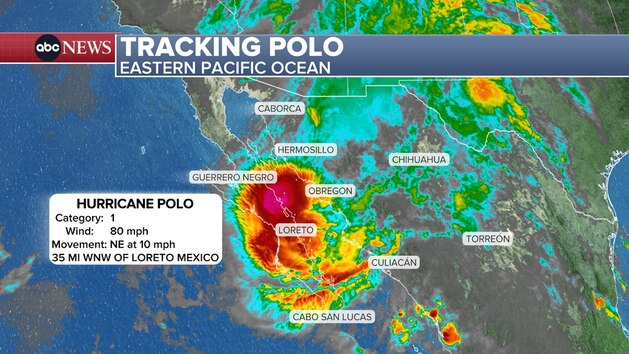
(NEW YORK) -- Hurricane Polo made landfall in Baja California overnight and is expected to make a second landfall on the mainland of Mexico on Tuesday.
Polo slammed the Baja California Peninsula near Las Barrancas as a Category 2 hurricane, packing dangerous winds of 96 to 110 mph.
After making landfall around 11 p.m. local time, Polo was downgraded to a Category 1 storm as it trekked across the Baja and took aim at the Sonora region of mainland Mexico.
There were no immediate reports of damage or injuries.
Polo formed into a Pacific hurricane on Sept. 20, one of three hurricanes to develop in the Pacific at the same time.
Near-record levels of moisture are coming in from the Pacific, aided by strong flow from Polo.
The hurricane's remnants will eventually merge later Tuesday with an existing storm system and supercharge moisture across a large swath of the United States.
More than 30 million people on Tuesday across a dozen states from California and Texas to Iowa are under a flood watch.
Overnight, multiple flash flood warnings were in effect across Utah and Arizona.
Zion National Park saw near-record flooding along the Virgin River and Heaps Canyon as a flash flood wave moved through on Monday night.
Water rescues were made on Monday evening in Bullhead City, Arizona, after a vehicle got trapped in floodwaters.
Police roadblocks and a cordon remained in place in the southwestern British village of Whelford on Tuesday morning, as the investigation continued into a possible terrorist plot near a key U.S. air base, with five men suspected of involvement arrested on Sunday but released on bail on Monday.
The men, who police said were all British nationals from London between the ages of 23 and 25, were arrested in the possession of three vans in the early hours of Sunday close to RAF Fairford, which has long been a key hub for U.S. Air Force operations in the Middle East -- including in the ongoing conflict with Iran.
Police said the men were suspected of terrorism and explosives offenses, prompting speculation that the detainees were planning to target RAF Fairford, possibly on behalf of a foreign power.
The men were bailed on Monday. Laurence Taylor, the head of National Counter Terrorism Policing in the U.K., said they were placed under "stringent conditions on their movement and contact with others." The suspects, who have not been charged, "remain under investigation as we explore multiple lines of enquiry," Taylor said.
"I know there is significant interest in whether the current geopolitical context has a bearing on this incident," Taylor said. "We are considering this from every possible angle. Including, that this may be activity committed by proxies, or individuals either knowingly or unknowingly, working on behalf of a foreign state."
Sunday's arrests, which came after a tip-off from a local farmer, were touted as a major policing and intelligence success. President Donald Trump was among those praising the operation, telling reporters on Sunday that it had been ongoing for a "long time."
Trump told reporters that the suspects were "looking to do big damage" to U.S. forces present at RAF Fairford. "The arrest in the U.K. was fantastic. Working with Britain, it was an amazing job," Trump said.
After they were bailed, Trump suggested the men "might be" linked to Iran, though declined to elaborate further.
"I'm surprised that they released them," Trump said on Monday during an Oval Office event. "I wouldn't have done that. Look, they've been very good. They worked with us very closely. We know everything about them. We would not have released them."
The Iranian embassy in London denied any connection to the incident in a statement issued on Monday. The mission condemned what it called "recent unfounded and malicious speculations published by some British individuals and media outlets."
"The circulation of such fabricated speculations, particularly in the aftermath of the criminal acts of aggression committed by the United States and the Israeli regime against the Iranian people, will serve no purpose other than to fuel Iranophobia propaganda in the UK," the embassy said.
Secretary of State Marco Rubio also suggested on Monday that the incident near RAF Fairford was linked to "a foreign actor," though said he had "to be careful" in what he shared publicly.
"There are some things I cannot say on the air for a lot of different reasons," Rubio said during an interview with Fox News. "Suffice it to say that what happened, what almost happened, what could have happened in the U.K. over the weekend is a very serious situation. It is one that clearly involves the hands of a foreign actor."
"I know a lot of people are disturbed by the news that some of these people have been released on bail," he added, thanking British authorities for their work and cooperation.
"We are dealing with elements in the world, in the case of Iran for example, who have openly threatened to attack American interests globally," he continued. "We're going to always take that very seriously, there will be repercussions for that if it ever were to happen or even attempted."
"There's a lot more news that will come out in the days to come, but there is only so much I can say right now at this point about it other than this is a very serious thing and will be responded to appropriately," Rubio said.
ABC News' Michelle Stoddart, Isabella Murray and Shannon K. Kingston contributed to this report.
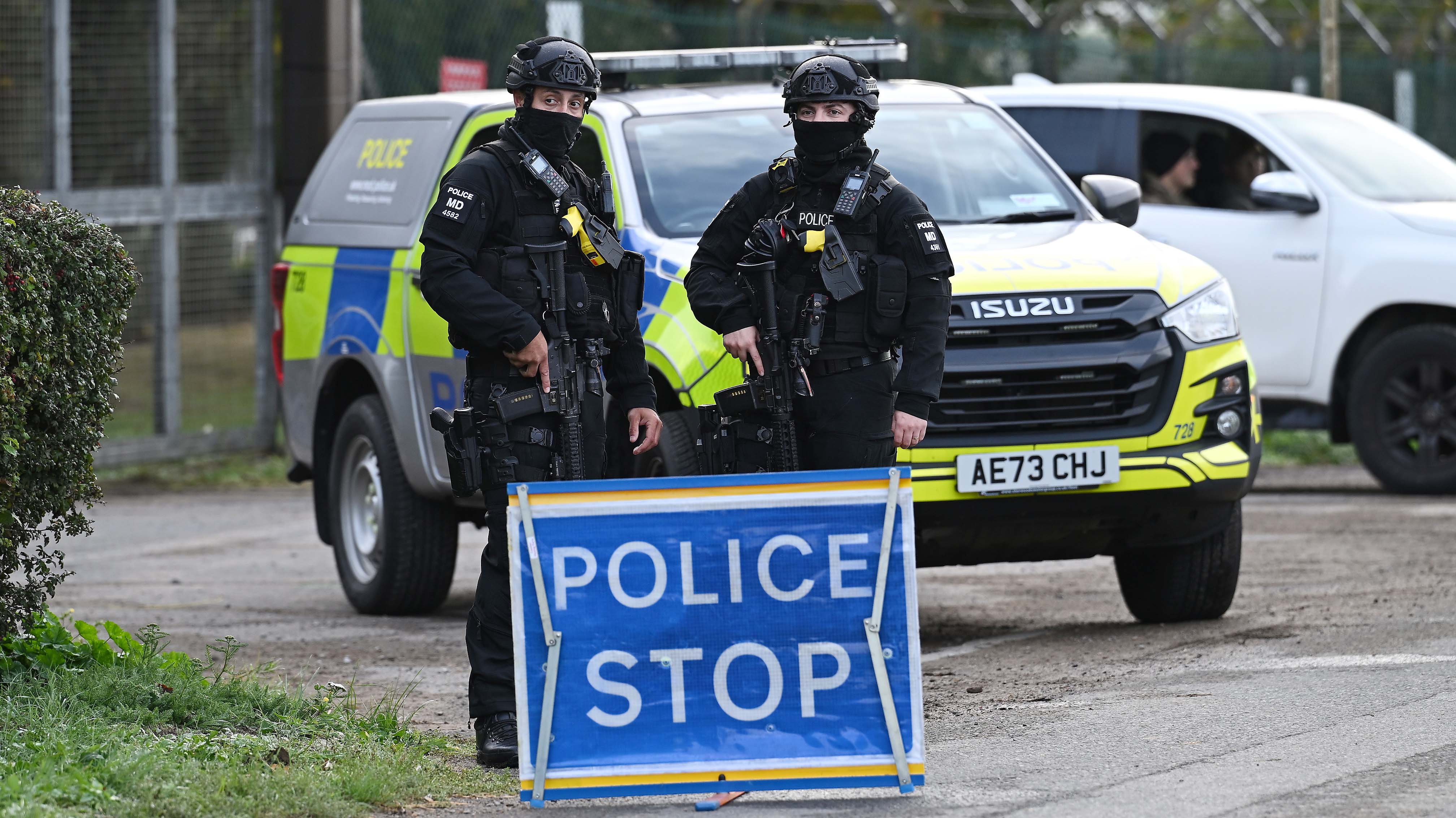
Armed police maintain road blocks and security checks around RAF Fairford on Sept. 28, 2026 in Fairford, England. (Leon Neal/Getty Images)
(LONDON) -- A police cordon remained in place on Monday near a major air base hosting U.S. forces in the southwest of England, where British police arrested five men early on Sunday on suspicion of terrorism and explosives offenses.
The men were detained in possession of three vans close to RAF Fairford, which has long served as a key European hub for the U.S. Air Force and a vital staging point for long-range operations in the Middle East -- including in the ongoing conflict with Iran.
Counter Terrorism Policing said on Monday that all five men arrested were from London, all were British nationals and all were aged between 23 and 25. They were detained "on suspicion of offences under the Explosives Act and preparation of a terrorist act contrary to Section 5 of the Terrorism Act," CTP said.
Police said they are still working to "establish the full circumstances of the activity of those arrested, their knowledge and any motivation behind this incident."
Speaking to BBC Radio 4 on Monday morning, British Defense Secretary Wes Streeting said he would not "comment in detail on operational security matters. Because, often, the more we might say the more insight we give to those who would wish us harm, and do us harm given the opportunity."
Streeting said the investigation was "well under way" and thanked those involved in the arrests, the evacuation of the town and the investigation. Police said that at least 85 homes were evacuated during their response on Sunday.
Streeting thanked an anonymous farmer -- who also spoke with the BBC -- who said she called in the threat after coming across the "hooded and masked" men and vans in the early hours of Sunday morning in the village of Whelford, close to RAF Fairford.
Streeting thanked the tipster for calling in the threat, though said the caller only "had a partial picture" of the situation. "I won't go beyond that, in terms of commenting on operational security matters," Streeting added.
The farmer told the BBC she believed authorities had "dropped the ball" in allowing the suspected attackers to get so close to the base.
Public frustration at the incomplete picture, Streeting continued, is "a small price to pay" to protect operational security. Streeting also refused to comment on the identities, aims or motivations of the five detained men.
Streeting declined to give further details on what police and intelligence authorities may have known about the alleged plot, though welcomed President Donald Trump's praise of an operation that he said had been ongoing for a "long time."
Trump told reporters on Sunday that the suspects were "looking to do big damage" to U.S. forces present at RAF Fairford. "The arrest in the U.K. was fantastic. Working with Britain, it was an amazing job," Trump said.
The U.S. military has used RAF Fairford intensively amid the ongoing war with Iran -- though so far no connection to Iran has been confirmed or established by authorities. The base has been used by American B-52 and B-1 heavy bombers operating in the Middle East.
When asked of potential Iranian involvement in the suspected plot, Streeting said he was not "drawing a connection with Iran," before adding, "We know that Iran and their proxies wish to do us harm."
The Iranian embassy in London denied any involvement in the incident, posting to X to condemn what it called "recent unfounded and malicious speculations published by some British individuals and media outlets."
"The circulation of such fabricated speculations, particularly in the aftermath of the criminal acts of aggression committed by the United States and the Israeli regime against the Iranian people, will serve no purpose other than to fuel Iranophobia propaganda in the UK," the embassy said.
"The Islamic Republic of Iran reserves the right to take appropriate legal measures, as necessary, to safeguard the rights and interests of the country and its people in response to misleading and damaging media narratives," it added.
ABC News' Victoria Beaule contributed to this report.